

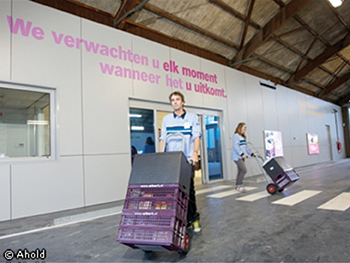
Ahold’s albert.nl online grocery offer has grown from a basic telephone-based service to a fully-fledged click & collect operation.
By / DENISE KLUG ASSOCIATE ANALYST, PLANET RETAIL
Netherlands-based grocery retailer Ahold has reported net sales of EUR 32.8 billion (USD 42.2 billion) for its full year 2012. This corresponds to an increase of 8.5% compared to the previous year. At constant exchange rates net sales were up 3.5%.
In the US, Ahold FY sales grew 3.1% to USD 25.8 billion with comparable sales up 1.9%. Sales at Ahold’s Dutch operations rose 5.2% to EUR 11.1 billion (USD 14.3 billion). In the Czech Republic and Slovakia, turnover was EUR 1.7 billion (USD 2.2 billion), down 3.7% or 1.8% at constant exchange rates.
Q4 Sales were up 4.3% to USD 6.1 billion in the US. Ahold said the performance was partly driven by “the exceptional efforts of our teams during Hurricane Sandy, which enabled our stores to remain open and to serve our customers during these difficult times.” The positive sales impact of Sandy was partly offset by a negative calendar impact due to the timing of the year end. The 15 Genuardi’s stores Ahold acquired in 2012 performed in line with expectations.
In the fourth quarter of 2012, turnover of Ahold’s Dutch operations jumped 7.7% to EUR 2.7 billion (USD 3.5 billion). This result was mainly driven by progress on Ahold’s growth initiatives, including the addition of 15 former C1000/Jumbo Supermarkten stores that were converted during the second half of the year. Identical sales growth was 1%, impacted by a negative calendar effect and a “disappointing performance” from drugstore chain Etos.
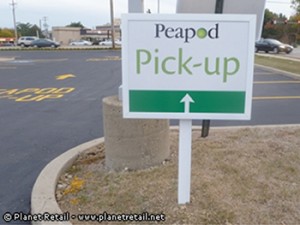
In 2012, Ahold opened eight pick-up points for its US grocery e-commerce operation, Peapod.
CLICK & COLLECT AS A GROWTH ENGINE >>
Ahold’s sales growth is strongly connected to its achievements in e-commerce and the retailer has been learning lessons from its proactive approach. Understanding that grocery home delivery is not viable in profit terms as, in the words of Chief Commercial and Development Officer James McCann, “it is exceedingly expensive to do the last mile,” Ahold has thrown itself into establishing a network of pick-up points for its own click & collect model, both in Europe and in its US operations. The company experimented with a variety of different strategies and soon discovered that picking the goods at a warehouse instead of instore was the way to go.
IMPLICATIONS >>
• Due to its active approach in e-commerce and extensive testing periods, Ahold has been able to learn lessons and press ahead with the most lucrative concept. At the same time, online business of some of its direct rivals is still in its infancy. Ahold has been able to create a competitive edge.
• The future will show whether Ahold’s Dutch non-food online shop bol.com is strong enough to withstand Amazon’s expected market entry and sustain its channel leadership.
Reporting its results, Ahold proudly highlighted the fourth-quarter opening of its first trio of standalone online grocery shopping pick-up points in the Netherlands. Ahold has been a trailblazer in this field in its home market, being the first Dutch operator to roll out an online grocery shop.
During 2012, Ahold also opened eight pick-up points for Peapod, its US grocery e-commerce operation– half of those in the fourth quarter. In August, Peapod inaugurated its first standalone collection point, in Abington, Massachusetts. Here, orders are picked in a Peapod ‘wareroom’ (similar to a dark store) and then delivered to a special storage locker at one of Ahold’s Stop & Shop locations.
Ahold intends to continue along this path as the growth of pick-up points is one of the six pillars of its strategy – and integral to its online expansion plans. The company expects its e-commerce division to turn a profit by 2016.
To achieve this goal, Ahold also plans to broaden its online assortment and increase the number of items in warehouses from 10,000 to 20,000 or 25,000, according to capacity. The assortment at Ahold’s Dutch online grocery shop has recently been extended by several thousands of new products.
BOL.COM’S STEADY GROWTH >>
Ahold is not only pursuing growth by escalating its grocery e-commerce business – it has also been busy expanding its online non-food segment. In May 2012, Ahold completed its acquisition of Dutch non-food e-commerce retailer bol.com. Following the takeover, it has increased the site’s catchment area and assortment. In the past, bol.com’s range has included books, entertainment, electronics and toys. Under Ahold’s management, new categories have been added: baby care, health & beauty and cooking & dining. The retailer has stated it will create three additional categories in 2013, without specifying what these will be.
Ahold is also looking to drive crosschannel opportunities with Albert Heijn supermarkets. In November, it created the first collection points for bol.com in 59 Albert Heijn stores. The aim is to eventually roll out this service to all outlets. Director of bol.com, Daniel Ropers, has reported positive initial results: “We expected that 2-3% of orders might be picked up at Albert Heijn, but now it is 5-6%,” he said. Spurred by this early success, the retailer has now also made it possible for bol.com’s online shoppers to collect orders at its new standalone pick-up points.
DEVELOPING ITS SECOND MARKET >>
Belgian online shoppers have always been able to use bol.com. Now, under Ahold’s stewardship, Belgium is to become a solid second pillar for the operation alongside the Netherlands. By the end of 2012, its Belgian user numbers had doubled in the space of a year.
Regarding bol.com’s future, Ahold promised at its Capital Markets Day in November to grow it “even faster over the next 18 months.” Considering the past and present expansion of this banner such a claim may sound feasible. However, bol.com’s core assortment and the essential elements of its strategies (e.g. the possibility of being an online sales platform for third party businesses and retailers) only bring to mind the mighty and massive Amazon.
One could get the impression bol.com’s success is only due to Amazon’s absence in the Netherlands. In many markets, Amazon has rapidly become the undisputed channel leader as it has, due to its sheer operational scale, managed to pulverise rival domestic online retailers – many of a similar size and boasting a success story akin to bol.com.
There have been speculations the e-commerce giant is looking to enter the Dutch market. Some anonymous sources even suggested Amazon.nl would be operational by September 2012. However, we are still waiting for this to happen. One suspects that, for Ahold and bol.com, the wait cannot be long enough.