

As the industry looks toward 2027, the global olive-oil sector is moving through a period of recalibration.
After the Mediterranean heat and drought driven supply shock of 2023–24, and the resulting price escalation that re-shaped sourcing strategies through 2025, production has bounced back in key origins. That recovery has helped wholesale prices retreat from their peaks.
Yet, like other sectors dependent on specialized agriculture, olive oil remains exposed to climate variability, inventories, trade-policy changes, and increasing consumer demand for quality and transparent labeling.
For procurement managers and food-industry executives, the outlook is dynamic. Improved supply conditions may ease input-cost pressure, but origin availability, tariffs, traceability, and brand trust remain central considerations when planning assortments, private-label programs, and long-term supply contracts.
Trade and Policy Landscape
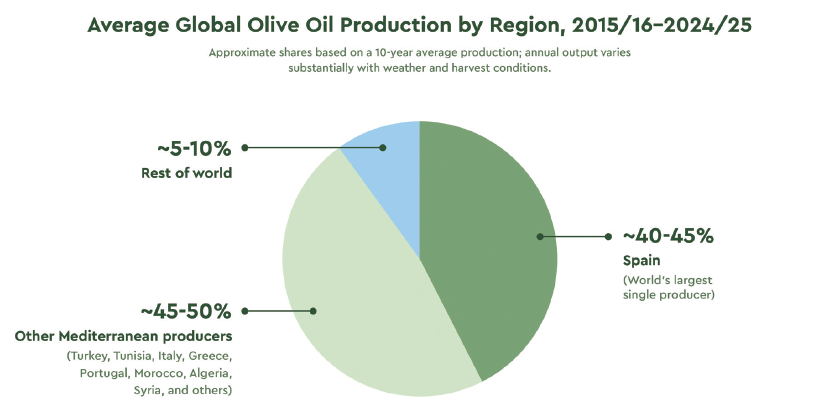
The Mediterranean basin continues to serve as the heart of global olive-oil production, accounting for over 80% of the world’s supply. As the leading producer, Spain typically generates 40–45% of the total output in a normal year. Its harvest determines not only the availability of bulk extra-virgin olive oil but also the global benchmark for origin prices.
Yet, for producing countries and olive oil brands, the strategic issue is no longer merely supply; it is investing in farming practices, accessing new sources, and diversifying their strategies to capture buying demand.
The United States remains one of the most promising premium markets for European olive oil, even if recent policy actions have pushed companies and states to adjust their strategies in the face of policy uncertainty.
Following a 2026 Supreme Court ruling resetting previous U.S. import tax rounds, the U.S. imposed new Section 301 duties over forced-labor concerns. At the moment, EU olive oil faces a 10% benchmark duty (including baseline MFN), while Morocco and Türkiye face 12.5%, and Tunisia is exempt.
To offset new frictions from an historical trade partner, the European Union has aggressively expanded its network of bilateral agreements through 2026, consolidating, streamlining and opening new channels across Latin America, Asia-Pacific, and Oceania.
Market Consolidation and State Initiatives
The largest North American corporate event of 2026 was Cobram Estate Olives’ acquisition of California Olive Ranch. The Australian company completed the US$173.5 million transaction in March, expanding its California footprint to roughly 3,300 hectares. The combined business now brings a sizeable portion of California’s olive-oil production under the influence of a single player.
Despite foreign and domestic investments boosting local supply, the U.S. olive oil market is set to remain structurally reliant on imports. Land, water, weather, and crop competition prevent domestic production from meeting North American demand anytime soon, with California, the leading domestic producer, accounting for only about 3% of U.S. consumption.
In Europe, in late summer 2026, Spanish cooperative Dcoop, already a shareholder in leading brands, made a €470 million bid for a controlling stake in Deoleo, a market leader owning major Italian heritage brands Bertolli and Carapelli, as well as Spain’s top international brand, Carbonell.
If finalized, the acquisition will firmly cement Spain’s dominance over the global branded sector and international distribution networks.

Meanwhile, direct state intervention in North Africa is also driving consolidation in the region. Following Bioliva Med Company’s financial collapse, a local court initiated a rescue plan to nationalize the enterprise, positioning its primary creditor, state-controlled BH Bank, as the majority shareholder.
This step has the potential to create a state-backed major player in Tunisia, notably the sole olive oil exporter exempt from the latest U.S. tariff measures.
In March 2026, consumers filed a proposed class action against The Gourmet Factory, Inc., alleging that certain Capatriti products marketed as “100% Pure Olive Oil” and “Extra Virgin Olive Oil” contained olive-pomace oil.
The complaint cites laboratory testing at an International Olive Council-recognized laboratory and chemical criteria that plaintiffs contend are inconsistent with the labeled grades. The allegations have not been proven in court.
The lawsuit illustrates continued legal scrutiny of olive-oil labeling and authenticity claims in the United States.
Against that backdrop, major European producing countries are investing in promotion, quality differentiation, traceability, and consumer education to suppor premium positioning.
The Search for Authenticity and Promotional Push
Elevated olive-oil prices in recent years have heightened consumer sensitivity to quality, origin, and authenticity.
In the United States, unlike in many major olive oil producing and consuming nations, quality control relies heavily on a patchwork of retailer specifications, private certification programs, trade-association initiatives, and the enforcement of general food-labeling laws.
Fortunately for the industry, recent testing shows promise. In 2025, the North American Olive Oil Association (NAOOA) released the results of a comprehensive retail testing program evaluating 190 off-the-shelf samples from top national and private-label brands.
The association testing found no evidence of undisclosed mixing with non-olive seed oils when tested against International Olive Council standards.
In Italy, the Ministry of Agriculture formally adopted the Piano Olivicolo Italiano 2026–2030, backed by €300 million in funding. The initiative aims to reinforce the value chain, combat structural threats like the devastating Xylella fastidiosa bacterium, and push toward an ambitious policy target of increasing domestic production by 25%.
Meanwhile, Spain is focusing heavily on cultural demand creation in the United States. In July 2026, the Spanish Olive Oil Interprofessional launched “All in a Drop,” a three-year, $25 million promotional campaign. The initiative leverages sobremesa—the Spanish tradition of lingering at the table after a meal— to position extra-virgin olive oil not simply as a cooking ingredient, but as a lifestyle.
Giovanni Quaratesi is Head of Corporate Global Affairs at Certified Origins, where he leads global communication strategies, stakeholder relations, and public outreach. With a deep commitment to food culture, innovation, and sustainability, he is a vocal ambassador for transparency and authenticity in the global food system. Whether representing Certified Origins at international forums or collaborating with public and private sectors, Giovanni champions initiatives that connect people to real food and support healthier choices.