


 By / DEREK MACKENZIE, Managing Director , designphase dba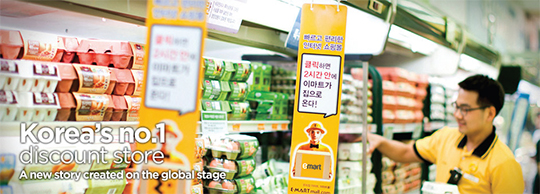
By / Irene tortore lla
If you are looking to immerse yourself in truly unique, well-provided, traditional retail in Korea, look no further than E-mart, Homeplus and LotteMart. Korea’s three major discount chains offer everything from the ubiquitous soju (distilled beverage made from rice, usually drunk neat) to ready-to-cook heamultang (spicy seafood soup).
Their private label products represent more than 25% of sales and occupy prominent areas in the stores around the Korean peninsula. Lotte Chilsung Cider (the first soft drink produced in Korea in 1950 by the Dongbang Beverage Partnership) already topped Sprite and 7up sales, it’s now time to see if Korean colas will outpace the beloved Coca Cola in the near future.
I think E-mart cola, when consumed with green tea crust Korean pizza from Pizza Maru, tastes much better than Coke. I swear it’s true. I know you’re now asking yourself how an Italian can enjoy eating Korean pizza with corn, sweet potatoes and sweeter sauce, but, you know, pizza is always pizza especially if outside the crew hotel it’s minus 10 and you don’t fancy tteokbokki –incredibly spicy rice cakes – before your well deserved sleep. (The publisher strongly disagrees me with on this!)
 For those looking for private label processed food, electronics, fashion items, baby products and ajumma brimmed hats for avoiding the sun during Korean summer there is no shortage of stock at E-mart stores. E-mart is absolutely a pioneer in private label retailing and has satisfied Korean customers (and now expats) since 1993.
Major supermarkets in U.S. such as Whole Foods, Walmart and Safeway have begun to stock Korean food products on their shelves, but I wonder why the global popularity and demand for them have grown so much. Is it just to satisfy the millions of Korean people abroad or because Korean food is healthy and tasty? Or because Korean food is healthy and tasty? Or perhaps it’s the Korean wave of popularity thanks to a certain singer? Few Koreans would ever want a meal without kimchi (fermented spicy cabbage based side dish). Startling to many foreigners at first but incredibly addictive once you get used to it, kimchi is full of more than 200 types of lactic acid bacteria, helping Koreans prevent high blood pressure and obesity for more than 2000 years.
My mother is 60 years old, attentive to skin care and my trusted doctor; she visited me in Seoul in 2010 and claimed that Korean women’s perfect skin secret was kimchi itself. Certainly South Korean Cosmetic private labels like Tony Moly, Missha, Nature Republic, Holika Holika and Skin Food played their own parts in this, providing good quality products at affordable prices.
Beans Box, a Korean brand dedicated to finding and sharing the world’s best coffee, is offering to the environmentally conscious in South Korea the opportunity to enjoy organic coffee and organic cosmetics at the same time. Each month the company selects a special coffee producer around the world and team that up with a organic cosmetics brand to provide four of its best products. In short, two of the Korean people’s favorite goods together make the perfect customer deal. Whilst stocks last.
 By / Richard Kohn
Reading marketing communications from any sizeable retailer you’d be excused for thinking that ‘Choice Quality and Value for Money’ is the standard retailers’ mantra: from Jeronimo Martins and Lidl to Tesco and Carrefour consumers receive the message that this is the mission of their favorite retailer.
Obviously, the private label offering sits within that positioning … normally as the paramount example (tiered of course through good, better, best and niche) of their choice, quality and value for money assortment.
Yet, the go to market concept, positioning and strategy of each of these retailers is widely different, as is the range and assortment available in their stores. So what’s going on here? An average Tesco store supports 30,000+ skus, the average Biedronka only 5,000. So in one case we assume it’s consumer choice and in the other choices made on your behalf by the retailer. In one case the range of different quality offerings is clear, in the other we assume that the retailer has specified a quality product.
Once upon a time, Choice, Quality and Value for Money were differentiators for retailers. This was an insight driven phrase with significant resonance with consumers. Over time however, the insights behind this promise have become less relevant and now, Choice, Quality and Value for Money are standard entry requirements for any retailer. This happens in many product categories – think for instance about the time when Soft strong and long meant something in toilet paper: now it’s simply expected by the consumer as a cost of entry to the category.
Why is all of this so important in private labels? Because private label and retail brands have the potential, when positioned correctly, to achieve the same level of consumer loyalty as well promoted, national brands. As we move out of the period of economic uncertainty and restraint, private label offerings have to be more than me too products to retain sales once consumer confidence picks up. They have to offer more than choice, quality and value for money.
Consumers expect to see and experience strong product positioning in everything that they buy today. It’s a key decision made during product development and one of the most challenging operational decisions commissioning buyers should consider pre-launch. For private label manufacturers it will be increasingly important to come to your retailers with a good, compelling story why the consumer should buy your version of the product. If not, who cares if it offers Choice, Quality and Value for Money.
Richard is an expert in global marketing and an acknowledged strategic brand leader. He currently heads the private label division at one of the largest retail pharmacy groups in Europe. He’s held senior management positions in A brand CPG companies and led international marketing and strategy teams across CPG, consumer durable and business services companies. He’s also the European client partner for a leading brand excellence training institute which delivers brand and communications courses to Fortune 500 companies. Richard is dedicated to bringing the discipline and science of brand marketing and marketing communications to private labels, empowering them to cultivate critically essential marketing management competencies to lead them to build leadership brands.
 By / Koen de Jong, Managing Director at International Private La bel Consult (IPLC)
Over the past two decades, private label food products have grown substantially in sales and often directly compete for market share with national brands. Competition between private labels and national brands within the store (intra-store competition) generates consumer welfare through lower overall prices and greater choice for shoppers in the supermarkets.
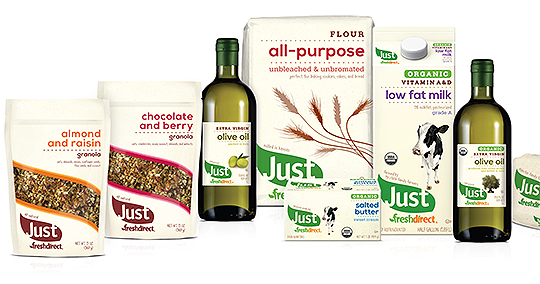
The average consumer does most of its shopping on auto-pilot. Statistics show that only 18% of shoppers have a list, meaning 82% of purchases are done from memory or prompted when in store. This makes it all the more important for a retailer to invest in attractive and consistent packaging design. Attractive to allow for effective competition with the national brands and consistent to navigate the consumer in his decision making when in the store thus reducing shopper stress. At ’the zero moment of truth’ when the product is about to be taken off the shelf, appealing pack design may be critically important.
More interesting is it to note that Private Label also has a strategic role in the competition between stores (inter-store competition). It allows the retailer to differentiate from other supermarkets as the assortment, prices, product quality and packaging can all be tailored to retailers’ specific needs, allowing them to offer something unique.
A while ago I met with a relatively small sized retailer in the Netherlands insisting on having a unique private label of its own. I argued that product volumes to be sourced would be very modest due to the limited number of stores. Therefore, buying conditions probably would appear to be unattractive making a launch not viable. I was surprised by his answer as he explained that although he realized buying prices would by considerably higher his company still wanted to move ahead as the overall objective was to have a unique private label range thus allowing for an independent pricing strategy of its own.
The opportunity to differentiate from the competition was considered of strategic importance for which he was willing to pay a price. We have supported this retailer as our client and launched a limited number of SKU’s in selected categories. With a packaging design carrying the store banner brand and in line with the store identity the products really stand out on the shelf and are easily recognized by the shopper. It is yet too early to evaluate but the first results seem to prove that this retailer is doing the right thing.