 February 10-13
 28-30 March
Bombay Exhibition & Convention Centre – Mumbai, India
For the first time ever, addressing India’s huge and growing FMCG market, this exhibition will deliver new opportunities for contract manufacturers, brand developers and product suppliers. Estimated at over US$20 billion, and growing rapidly, the Indian retail market is open to the world and ready to do business.
This new exhibition aim is to help facilitate new relationships and develop new customers, sources and trading partners across this important, exciting, fast-developing region. Private Label India 2013 will allow global industry leaders to meet and network with leading Indian retailers, distributors, and wholesalers for the first time ever.
Product sectors include: food and beverages, nutrients, cosmetics, health and beauty products, paper and plastic products, cleaning, pharma and hygiene, industrial consumables, white goods, household products and kitchen goods.
For more information…www.privatelabelindia-expo.com.
 On October 12, 2012, I learned that the magazines I had spent the previous ten years improving were sold to a company that I had spent the last ten years competing against. I also learned that I was unemployed. I’ve had better Fridays.
So I did what any self-respecting publisher would do, I went to Paris. Amazing what some good food, wine and the company of family and friends can do for the soul. While in Paris, my wife and I visited our niece, Alexandra Creange, who was studying at the American University and we spent some time with my good friend and colleague Jacco van Laar.
Over food, drinks and a few cigars, Jacco and I discussed life, family, future. We examined what we like to do, what we would rather not do, etc. We both realized that we truly enjoy this industry and publishing a magazine that supports the best of what private label can be. It was too soon to say goodbye to all our friends, so we decided that we had to continue.
Upon my return from Paris, I went to PLMA’s Chicago Show to quietly “float” the idea of a new, global retail brand magazine. The reaction was very positive and, as they say, the rest is history.
What you are now reading is our first effort. Liken it, if you would, to the first offering of a recently planted vineyard. While it conveys the essence of what we intend to become, it is only a beginning. Like wine, we will improve with age.
It would be impossible to thank everyone who made this possible, but I must thank a few people, without whom, it would have been impossible. Jacco van Laar for his friendship, encouragement and driving skills, Charyliz Rodriguez for her design vision and ability to tolerate me, my Mom, Maria Russo who introduced me to a publishing company at the influential age of 16 and finally, my beautiful wife Ann, my hero and daily source of inspiration.
And I would feel real bad if I didn’t also express my gratitude to – John Angiolillo, Philip Shaoul, Koen de Jong, Christopher Durham; Natalie Berg and Planet Retail, Sabine Geissler,
Irene Tortorella and our friends at – DEK; Drogheria & Alimentari; Fattorie Giacobazzi; Freiberger Pizza; Global Tissue Group; Icco Cheese; MarcabyBolognaFiere; MDD Expo;
My-Private Brand; NP Foods; Own Label Show; PL Sourcing; PLMA; Tonitto; Toy Fair 2013; Tuttofood 2013; Vossko GmbH & Co. KG
We hope you like what you read, would love your opinions and…thank you for your time and support.
Phillip Russo
Publisher / Editorial Director
phillip@globalretailmag.com
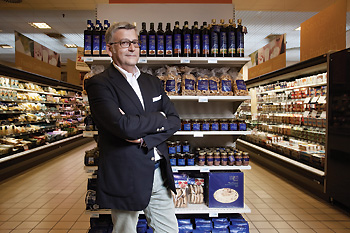
Written / SABINE GEISSLER
Ah! Italia! Crisis, recession, negative figures: Italy is often indicated as one of the most uncertain European countries and as a risk for the Eurozone.
In Italy, the sales volume in the traditional retailers show a negative trend, sales of non-food products are going down, per sales-receipt gets lower, consumers are turning to high convenience distribution channels (discounts) and sales due to promotions are increasing (25,7%, with a peak of 27,3% in October 2012 and of 34,5% in the hypermarkets). In search of convenience, consumers alter their buying behavior, shopping less in hyper and supermarket formats, shifting to discounters and superstores.
In the midst of all this, we can fortunately point to an amazing case of excellence and growth: In 2012, Conad, a cooperative and one of Italy’s leading retailers with 3.052 stores (40 E.Leclerc Conad, 180 Conad Superstore, 918 Conad, 862 Conad City, 790 Margherita, 192 Todis and 70 other channels) invested 400 million Euro in the creation of 106 new stores, and has created 4.400 new jobs.
Today, Conad is present in 108 out of the 110 Italian provinces and will close the financial year 2012 with a turnover growth of 8%. More precisely, according to Gnlc Nielsen, the foreseen 2013 turnover is of €10.970 billion, €809 million more than in 2012 (+7,96%).
Gnlc Nielsen also reports that Conad’s growth comes from the development of its sales network and market share gains of 17,6% in the supermarket sector (increase of 4,1% when compared to 2011) and 14,1% in neighborhood stores (+6,8% when compared to 2011); the market share in the hypermarket segment is of 4,6%, with a total market share (average of all sales channels) of 11,1%, which corresponds to a growth of 0,8% when compared to 2011.
This results owe a great deal of thanks to good performance of the Conad private labels, where sales have grown when compared to 2011 with a value of €2.089 billion and a share of 25,1% which is superior to the average private label sales share of the Italian market (18,1%). This performance is possible thanks to the product quality of the Conad private label ranges, which is similar to A-brands, but with a cost-saving of about 25-30% (source: Symphony Iri)
According to the Conad’s general director, Mr Francesco Pugliese, “we grew in all channels primarily thanks to private label products and fresh food. In 2012, we have achieved much more than forecasted: 400 million Euro of investments and 4.400 new jobs. Conad is economically solid and has targets of further growth, because the absolute leadership of the retail market is a reachable target”.
Conad started a multi-tier private label program years ago, with the creation of specializations and services in addition to the traditional supermarket product range.
Conad operates 9 opticians corners and 55 para-pharmacies, where the OTC pharmaceuticals, para-pharmaceuticals and products for personal care are sold with savings of around 21%, sometimes as much as 40% when compared the traditional opticians and pharmacies.
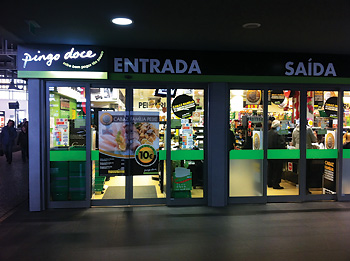
Conad has focused on smaller store surfaces located in the cities, whereas other retailers invested more in big surfaces located out of the towns. This policy of smaller stores has been successful and Conad operates three shop formats “Conad City”, “Conad Margherita” and “Sapori & Dintorni”, the latter one, shown here, specializing in regional Italian food specialties and gourmet food.
A CLEARLY STRUCTURED PL STRATEGY >>
Conad’s multi-tier private label range is clearly structured and carries today the following brands:
CONAD >>
Over 1000 products distributed in different categories, for daily use and with a sharp quality-price relationship. The Conad-branded food products exclude the use of GMO and utilize a traceability system from the raw material origin to the ready product.
CONAD IL BIOLOGICO >>
The organic range with the brand Conad il Biologico carries organic food products for everyday consumption. Some products are also certified Fairtrade, such as bananas, some chocolate and coffee.
CONAD KIDS >>
Food products specifically for children, which offer balanced nutrition for with regard to controlled calorie input and reduced salt and fat contents. Conad Kids uses a mascot, comic-Lion design on all packages and the range includes breakfast items, cookies and juices.
CONAD PERCORSO QUALITÀ >>
This private label brand identifies fresh meat, fish, seafood, fruits and vegetables under a wholly controlled production chain to offer best quality fresh food.
The quality controls and analysis are carried out from the source, during transport and to the shelf and and allows Conad to get the fresh food in a minimum time to the consumer to assure quality, food safety, healthiness and freshness.
AC ALIMENTUM CONAD >>
For consumers with specific nutritional exigencies and positioned as a “daily help for the wellbeing of the whole family”, it is divided further into: Cuore includes food which can help to control the cholesterol level in the blood Regolarità includes food which aids the balance of the intestine bacterial flora Difesa includes food which helps strengthen the natural defense of the immune system Alta Digeribilità includes food for lactose intolerant people.
Conad is also working on a Linea Senza Glutine with gluten-free food products.
CONAD PIACERSI >>
Is range of foods with low fat, low calories, no sugar and rich in fiber.
A PIONEER WITH THE SAPORI & DINTORNI PREMIUM PRIVATE LABEL RANGE >>
Sapori & Dintorni:
The Sapori&Dintorni brand was introduced by Conad in 2001 with about 210 food items, which then represented about 10% of the Conad assortment. It is dedicated to local Italian gourmet specialities and it promotes the food culture of single Italian regions. It was the first private label specialty food brand to be exported, where Conad worked as a selector of a qualified Italian food range to be sold in retailers in France (E.Leclerc), Switzerland (Coop Suisse) and Belgium (Colruyt).
Today, all major retailers in Europe carry a gourmet food premium range, as shoppers in developed markets look for “value” and retailers seek to build loyalty with specific consumer groups. These shoppers are educated, critical, informed and mostly in medium-high social positions, with a good income. Retailers are obliged to offer real premium food ranges to keep them away from specialty stores, organic stores and local fresh food marketplaces.
The development of premium ranges has lots of benefits for all players: it allows small and medium sized producers of local traditional quality food to offer themselves as partners of the retailers; it allows the retailers to respond to an increasing demand for transparency of the sourcing, to quality food obtained from healthy raw materials, made with a real, human know-how.
A private label range becomes a Retail Brand
In 2010, Conad went one step further and opened the first two stores under the Retail Brand “Sapori&Dintorni”. These first stores of about 400 square meters opened in Florence with an assortment dedicated to the Sapori & Dintorni branded food with spaces for tasting, as well as museum ticket office and information of the cultural life and activities of Florence.
Performance of these two stores is excellent with profitability of more than €20 thousand per square meter, one of the best figures in Italian retail. It’s a high traffic location due to the services offered and fresh food which accounts for 65% of the turnover.
As a result of this success, in December 2012, Conad announced an agreement with Grandi Stazioni Spa for the opening of four innovative Sapori & Dintorni stores in four train stations. By June 2013, they will open in the stations of Milano Centrale, Firenze Santa Maria Novella, Roma Termini and Napoli Centrale, with a surface between 800 and 1.000 square meters each, creating many new jobs.
These are bigger store dimensions when compared to the first 2 Sapori & Dintorni Stores, where Conad can display better a wide assortment of premium food: more than four thousand items, among those all the food items with the Sapori&Dintorni brand, further to 500 local excellence products and a wide choice of locally sourced fresh food.
“It is an important occasion to satisfy concretely the demand for quality products also in places where there are moving many people like train stations and to contribute distinctively to the re-qualification of urban spaces which need to live also beyond the function they have been built for” says Conad general director Mr Francesco Pugliese.
Pretty amazing what a Private Label can do.
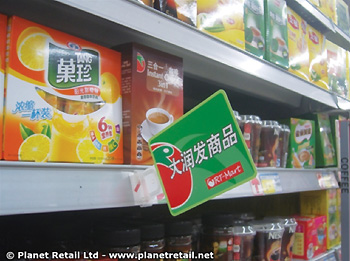
Right / RT-Mart, the leading hypermarket operating company in China, has spread its private labels in many categories and still expanding.