

First Survey Finds “Performance Trust” Is Key to Store Brand Growth in Personal Care
PLMA has launched Shopper Intelligence, a new research initiative meant to give retailers and suppliers shopper-level evidence for store brand strategy. Its first study, Store Brand Reach in Personal Care, finds that shoppers’ confidence in how a product performs does far more than price to drive store brand adoption in personal care.
“Performance trust drives store brand adoption five times more than price,” said Dr. Sara Williamson, Ph.D., the study’s author and a faculty member at SUNY College at Old Westbury. “The proof shoppers need varies by category, and success in one category can increase the likelihood of store brand adoption in another.”
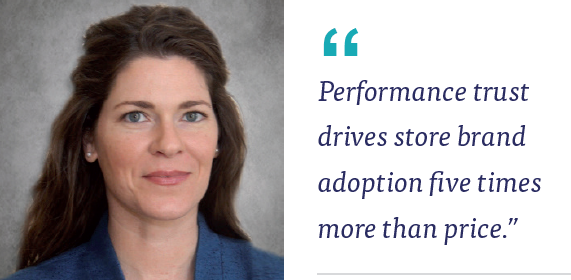
The survey of about 1,500 U.S. shoppers looks at how consumers perceive, choose and hesitate over store brands across fourteen personal care categories. According to PLMA, the results show where retailers and suppliers should invest, which category-level barriers they need to overcome, and how a single product win can become a broader category growth plan.
For private label product and brand teams, the main takeaway is that the case for store brands in personal care rests on proof of performance more than on price. Because the proof shoppers want differs from one category to the next, a single approach across the whole personal care aisle is unlikely to work. The study also points to a halo effect: shoppers who trust a store brand in one category are more likely to try it in others. Retailers can use that to build adoption across categories instead of treating each product on its own.
Williamson called personal care “one of the most promising open frontiers for store brands.” She will present the full report on Sunday afternoon at the PLMA Trade Show.
Through Shopper Intelligence, PLMA plans to give its members research on shopper behavior that they can act on as private label keeps growing in more categories.